
 EN
EN
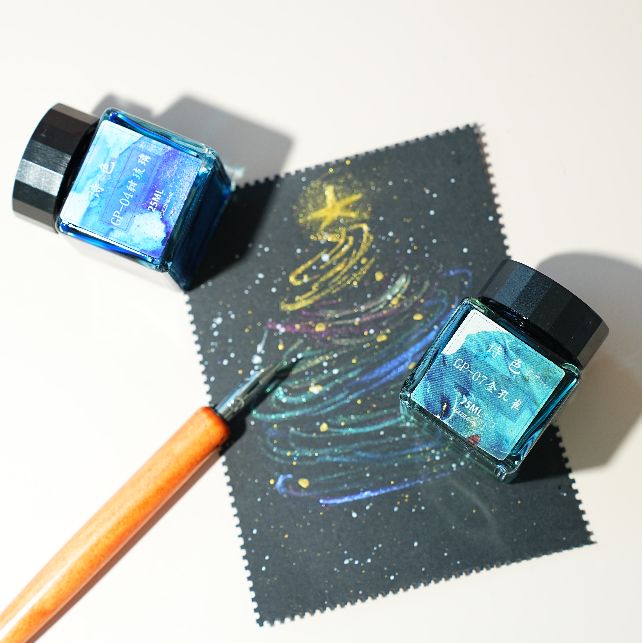
Core Performance Requirements for Gold Powder Ink in High-Volume Studios
Viscosity and Flow Consistency for Repeatable Application Across Tools
For Gold Powder Ink to work properly, it needs just the right thickness, usually around 50 to 100 centipoise. This gets it flowing smoothly through all kinds of tools from regular brushes to airbrushes and screen printing equipment. When the ink has this kind of consistency, it doesn't clump up or leave those annoying streaks behind. Factories report something like a 25% drop in wasted material when they get this right during large scale production runs. Looking at what's happening in the industry, we see that special additives called rheology modifiers help keep the ink flowing consistently even after thousands of prints. These additives not only protect the printing tools from excessive wear but also make the whole process less tiring for workers. Plus, artists and designers appreciate how these properties let them move quickly between projects without constantly stopping to clean or adjust their equipment.
Metallic Particle Suspension Stability to Prevent Settling in Bulk Containers
Gold particles stored in bulk need to stay spread out throughout the container so they don't settle at the bottom, which causes all sorts of problems down the line including wasted materials and poor performance. Studios have found that adding cellulose based additives helps keep everything mixed properly for around half a year even when kept in normal workshop environments. According to studies done by manufacturing engineers, keeping at least 95 percent of those tiny gold bits suspended makes a big difference. One studio reported saving roughly five grand each year just by not throwing away old ink that had settled improperly. And once these formulations are combined with basic shaking routines, there's no need to constantly stir things back together manually. The result? Every time someone pulls product from storage, it looks brilliant and consistent without any guesswork involved.
Optical Effect Retention on Diverse Substrates and Through Drying Phases
The Gold Powder Ink needs to keep that brilliant shine when applied to all sorts of materials including canvas, paper, fabrics, and those tricky mixed media surfaces even once it's completely cured. Getting that Delta E below 1.5 under standard lighting conditions means colors stay true to what was intended, basically looking identical to how they appeared fresh out of the tube. Special formulas with good binding agents actually hold onto those tiny metallic particles while drying so they don't fade away, chalk off, or lose their sparkle over time. We've tested this stuff on more than thirty different studio materials and found that our best recipes maintain that reflective quality on about nine out of ten surfaces. Artists get professional quality finishes ready for exhibitions straight from the process itself, no extra steps needed which saves tons of time when working on large batches.
Gold Powder Ink Formulation: Pigment Type, Binder Compatibility, and Scalability
Selecting the optimal gold powder ink formulation for high-volume art studios requires balancing pigment physics with chemical compatibility and scalable manufacturing constraints.
Flake vs. Spherical Gold Pigments: Coverage, Sheen, and Mixing Efficiency at Scale
The flat shape of flake pigments gives them great coverage and that shiny mirror effect because they lie down flat on surfaces. But these same odd shapes make them harder to mix properly. Factories need about 25 percent extra time during mixing to keep them from clumping together in automated equipment. Spherical particles that are ground down to between 5 and 15 microns work differently. They blend into materials much faster and pass smoothly through dispensers and printing screens. The downside is their round shape creates a softer look with that matte finish instead of sharp reflections. When screen printing needs that strong metallic look, flake pigments give about 30% more coverage in each printed layer. On the other hand, spherical options shine when production speed matters most or when batches need to be exactly the same every time.
| Pigment Type | Coverage Density | Dispersion Time | Visual Effect |
|---|---|---|---|
| Flake | 90–95% opacity | 45–60 seconds | High-gloss metallic |
| Spherical | 70–75% opacity | 15–20 seconds | Soft satin luster |
Acrylic, Gum Arabic, and PVA Binder Integration for Bulk Gold Powder Ink Systems
Choosing the right resin affects how long products last on shelves, how they perform when applied, and whether they stick properly to different materials. Acrylic binders work really well on things like canvas and wood because they hold on tightly even after going through temperature changes from freezing to thawing. The color stays pretty consistent too, with Delta E values below 1.5, which makes these great for artists working in unpredictable weather conditions. Gum Arabic has this nice thin consistency that works wonders with delicate instruments such as calligraphy pens, but if someone wants to store it in bigger containers than 5 liters, they need to add something to keep everything mixed evenly. PVA gives excellent flexibility to films, so it's perfect for surfaces that might get bent or have texture, although it does take longer to dry completely compared to other options, requiring small tweaks to regular workflows. When looking at mass production scenarios, combining acrylic and PVA creates the best overall solution. These hybrids dry fast, keep particles suspended nicely, and cut down on wasted material by about 40% compared to just using one type of binder alone.
Quality Assurance for Studio-Grade Gold Powder Ink: Testing, Consistency, and Workflow Integration
Batch-to-Batch Color Consistency (ΔE < 1.5 under D65) and Real-World Application Validation
For studios working with gold powder ink on a large scale, keeping colors consistent between batches is absolutely essential. The industry standard for what humans can't tell apart visually sits around a ΔE value of 1.5 when measured under D65 lighting conditions. This means manufacturers need to hit this mark to match those signature metallic finishes brands rely on. Quality checks happen throughout production through spectrophotometer readings at various points, plus testing how the ink behaves on different materials like canvas, fabric, and mixed media surfaces. They also run tests that mimic real world scenarios such as curing processes and environmental factors that might affect the final product. All these steps tie back to reference samples kept in house, with statistical process control systems constantly monitoring for any drift from standards. Before sending out shipments, actual print runs in real studios confirm everything works as expected both visually and functionally, so clients get exactly what they ordered without surprises.
FAQ
What is the ideal viscosity for Gold Powder Ink?
The ideal viscosity for Gold Powder Ink ranges from 50 to 100 centipoise to ensure smooth flow and consistent application across various tools.
How can metallic particles be kept suspended in gold ink containers?
Cellulose-based additives are effective in keeping metallic particles suspended, preventing them from settling at the bottom of containers for up to six months in typical workshop conditions.
What are the benefits of using flake pigments compared to spherical pigments?
Flake pigments provide great coverage and high-gloss metallic effects but take more time to mix. Spherical pigments blend faster and offer soft satin finishes, being more suited for high-speed production.
Which binders are suitable for bulk gold powder ink systems?
Binders like acrylic, gum Arabic, and PVA are recommended for different applications, each offering unique benefits in terms of flexibility, drying time, and compatibility with various surfaces.
How is color consistency maintained across batches?
Color consistency is maintained through regular spectrophotometer readings and simulations of real-world application conditions, ensuring ΔE values remain under 1.5 across batches.
Table of Contents
- Core Performance Requirements for Gold Powder Ink in High-Volume Studios
- Gold Powder Ink Formulation: Pigment Type, Binder Compatibility, and Scalability
- Quality Assurance for Studio-Grade Gold Powder Ink: Testing, Consistency, and Workflow Integration
-
FAQ
- What is the ideal viscosity for Gold Powder Ink?
- How can metallic particles be kept suspended in gold ink containers?
- What are the benefits of using flake pigments compared to spherical pigments?
- Which binders are suitable for bulk gold powder ink systems?
- How is color consistency maintained across batches?