
 EN
EN

In our previous analysis, we explored the complex safety formulations, colloidal chemistry, and industrial production processes required for high-performance edible children's paints. However, an inherently non-toxic or edible-grade formulation does not automatically guarantee total real-world safety during unmonitored play.
A critical yet frequently overlooked element in chemical product design is how to behaviorally deter young children from swallowing paint in the first place. Formulating for passive safety is only half the battle; stopping the ingestion impulse at the gustatory level brings the strategic addition of bittering agents into sharp focus.

What is a Bittering Agent?
Also known as an aversive agent or oral deterrent, a bittering agent is a specialized chemical additive that imparts an intensely unpleasant bitter taste to a product, creating an immediate behavioral reflex that prevents accidental or habitual ingestion by children.
In the field of children's finger paints and tactile art medias, all major global regulatory frameworks including Europe's EN71-7 , international benchmark ISO 8124-7 , and China's national mandate GB 6675.14 explicitly enforce the addition of standardized bittering agents. Notably, recent regulatory updates such as the European standard EN71-7:2025 have further solidified this mandate, making quantitative bittering verification a core compliance indicator for market entry.
The two primary bittering agents approved across international standards are:
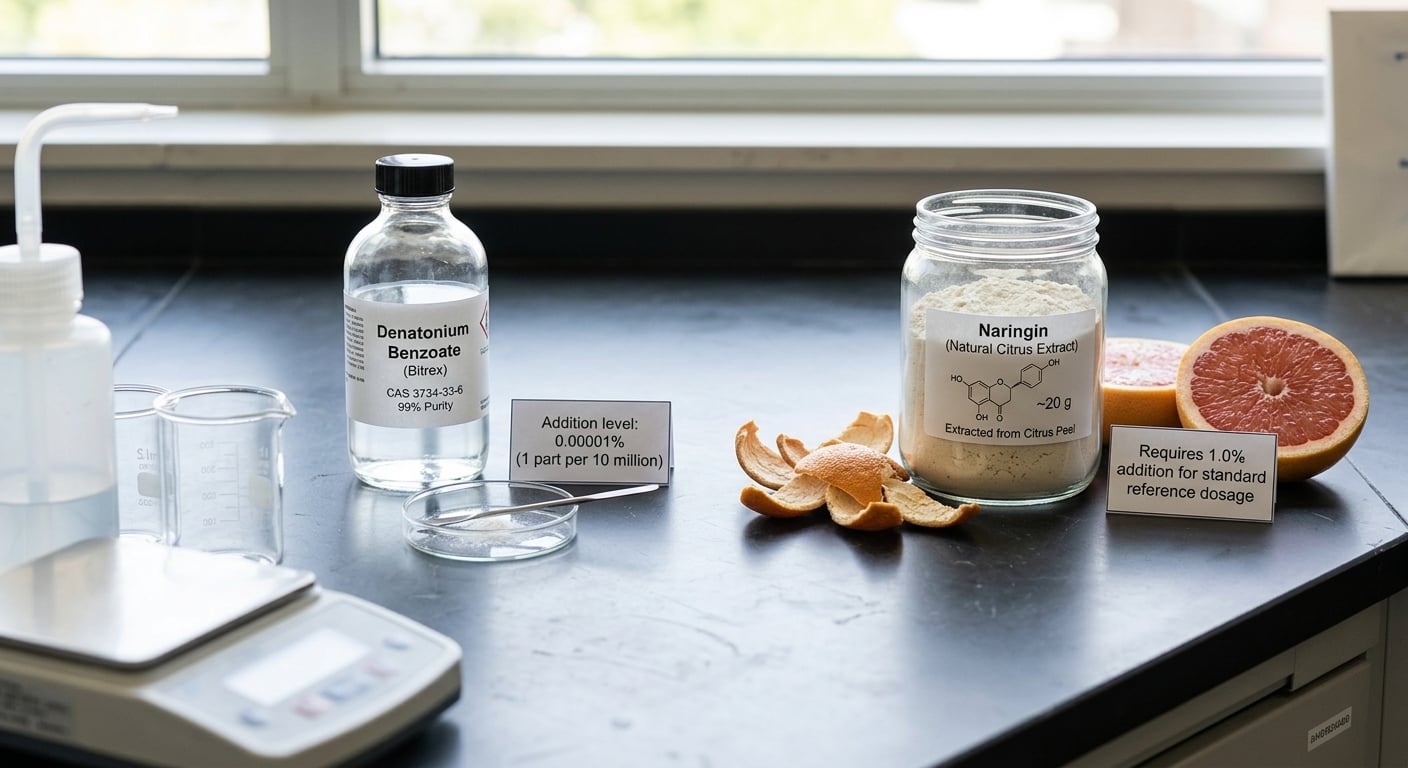
- Denatonium Benzoate (Bitrex): Recognized scientifically as the bitterest compound known to humankind. It is roughly 1,000 times more bitter than quinine. An addition level as extraordinarily low as 0.00001% (1 part per 10 million) is sufficient to trigger an immediate gag or spit response. With an acute oral toxicity rating (LD50 in mammals) of approximately 841 mg/kg, it provides complete physiological safety at conventional micro-dosing levels.
- Naringin: A natural dihydroflavonoid compound extracted directly from citrus peel (primarily grapefruit). Measuring approximately one-fifth as bitter as pure quinine, naringin offers a completely natural, edible, non-toxic, and readily available bio-based alternative for organic or plant-derived art lines.
Standard Reference Dosages: International compliance benchmarks specify minimum target inclusion rates of either 1.0% Naringin or 4 mg/kg (0.0004%) Denatonium Benzoate to guarantee reliable gustatory deterrence across all mass production batches.
Why Add a Bittering Agent?
Core Principle: The biological instinct of infants and toddlers to explore their environment through oral contact cannot be prevented through verbal warnings or cognitive education alone.
Infants and young toddlers inhabit the oral sensory stage of early psychological development, instinctively using their mouths to perceive texture, temperature, and consistency. Even when a container features prominent warning labels reading "Non-Edible" or "Do Not Ingest," these textual directives are meaningless to an early-stage learner.
Finger paints present a unique exposure pathway: because they are applied directly using palms and fingers, high volumes of wet paste adhere to the skin. Children are exponentially more likely to lick their fingers during sensory play than they are to bite an industrial paint brush.
Without an integrated bittering agent, accidental ingestion of paints even those made with food-grade preservatives and dyes can still cause minor gastrointestinal distress or introduce unwanted raw mineral oils in bulk. Micro-dosed bittering agents hijack the child's innate evolutionary taste aversion. The instant the tongue contacts the paint, the overwhelming bitterness forces an immediate spitting reflex, halting consumption in milliseconds.
Key Application Points in Industrial Production
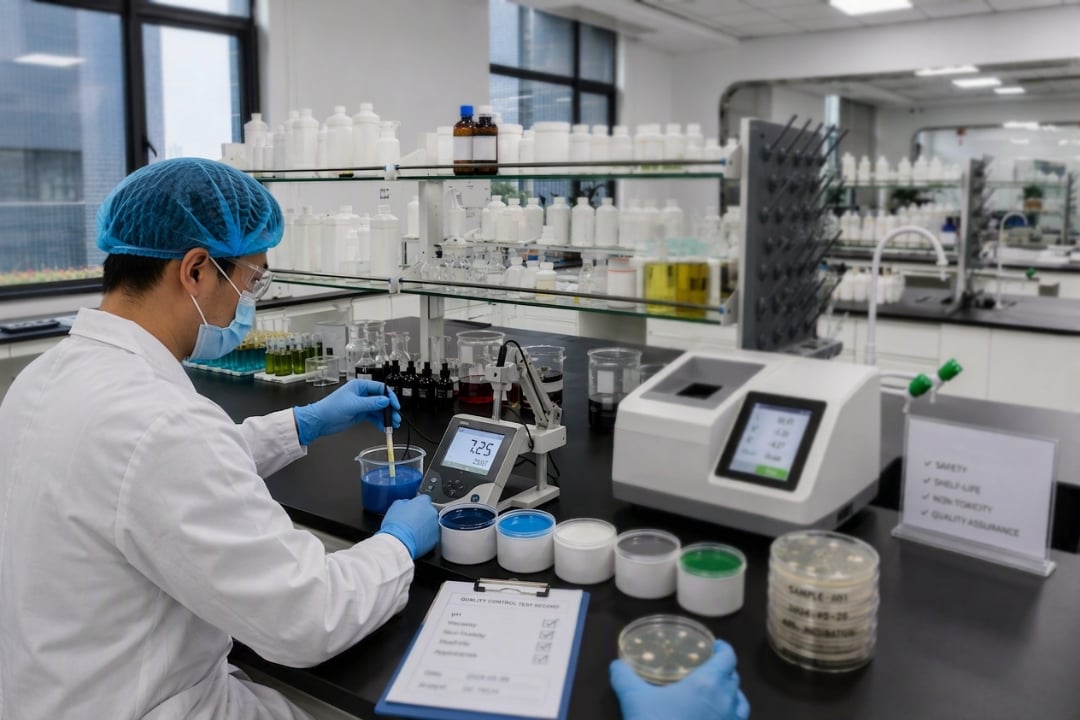
Integrating micro-dosed bittering agents into commercial paint production requires precise chemical control to ensure uniform efficacy throughout the entire shelf life:
- 1. Target Market Regulatory Compliance: Formulation teams must verify that both the compound identity and active concentration precisely match the destination market's legal mandates (eg, EU EN71-7, ISO 8124-7, GB 6675.14).
- 2. Phase-Specific Dissolution & Dispersion: Denatonium benzoate exhibits high water solubility and should be pre-dissolved within the initial aqueous phase alongside glycerin and water-soluble polymers. Conversely, naringin shows limited solubility in cold water, requiring pre-heating or high-shear premixing during raw material prep to avoid micro-clumping.
- 3. Thermal & Chemical Stability: Denatonium benzoate is extraordinarily resilient against thermal degradation, surviving standard 60–70°C emulsification cycles and high-shear homogenization without losing its biological potency.
Conclusion: True Safety is Behavioral
If a food-grade, edible paint matrix provides non-toxic safety at the ingredient level, then an integrated bittering agent establishes a critical second line of defense at the behavioral level. It does not rely on active adult supervision or childhood self-control; instead, it leverages innate biological survival instincts to halt ingestion before a harmful quantity can be consumed.
This dual protection framework is precisely why global toy safety standards mandate bittering additives for finger paints. True engineering safety isn't merely about creating a product that won't harm a child if swallowed it is about designing a product that a child simply will not want to swallow .